

Open Artificial Intelligence (Open AI) refers to artificial intelligence systems developed with accessibility, transparency, and collaborative principles at their foundation. The technology transforms our daily routines, professional environments, and global industries. Yet, discussions surrounding this technology often feature a specific term: Open Artificial Intelligence.
Many people encounter this phrase in news headlines, technology blogs, and business meetings, but few understand its true meaning.
This guide breaks down the core concepts of open artificial intelligence, explores its significance, and explains how this revolutionary technology shapes our collective future.
Defining the Key Difference
Traditional technology companies historically built proprietary systems. These corporations locked their source code, algorithms, and training methodologies behind closed doors. They maintained total control over their creations, limiting public access and independent research.
Conversely, the open AI movement champions a decentralized approach. Creators of open artificial intelligence share their foundational code, models, and research findings with the global community. This philosophy empowers independent developers, academic researchers, and everyday enthusiasts to examine, utilize, and improve existing technologies..
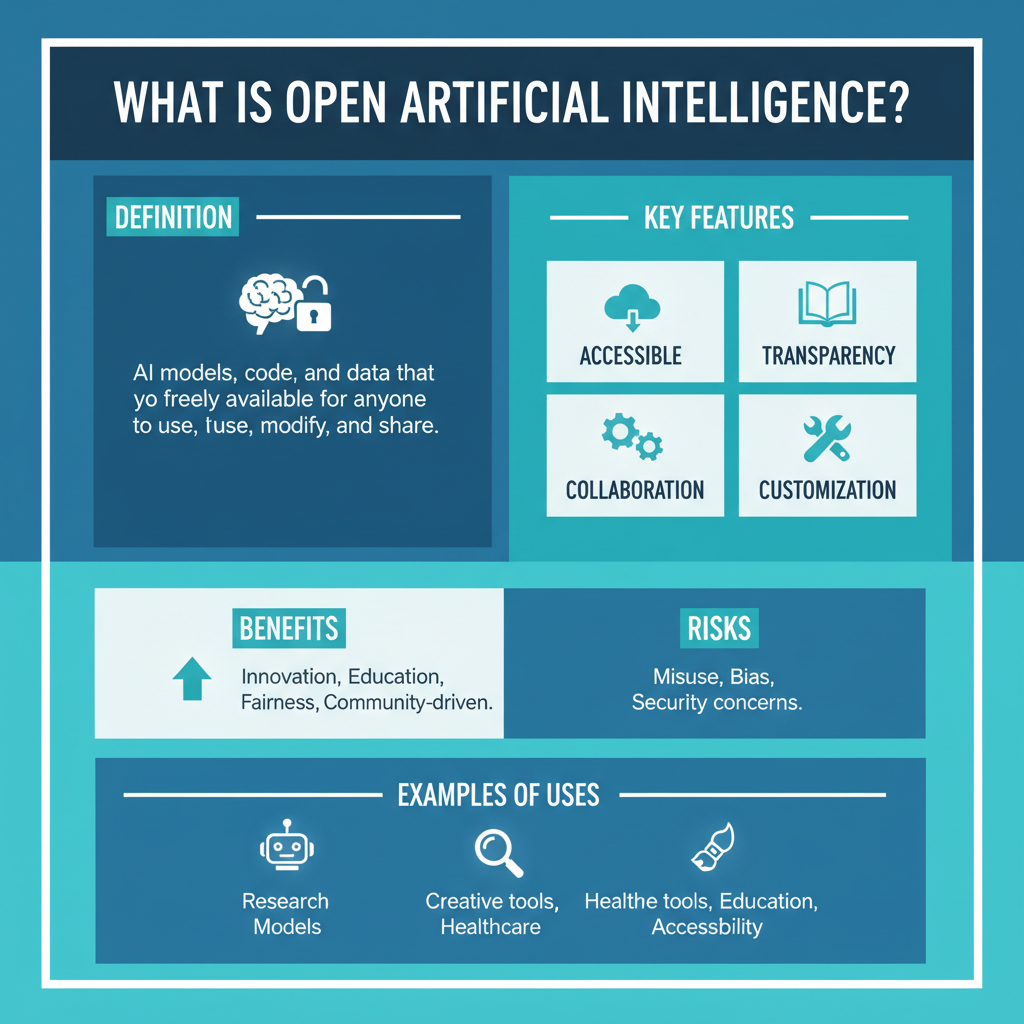

Key Characteristics of Open AI Systems
- Accessibility: Developers make foundational models available for public download and deployment.
- Transparency: Creators publish research papers, training data parameters, and architectural frameworks openly.
- Collaboration: Global communities contribute code fixes, security enhancements, and new features collectively.
- Customization: Users possess the freedom to modify models to suit specific personal or organizational needs.
Why Open Artificial Intelligence Matters Today
The rise of open artificial intelligence marks a major turning point in human technological history. Previously, only massive multinational corporations possessed the financial and computational resources to build advanced intelligence systems. Open AI democratizes this power.
1. Democratizing Technology
Open frameworks level the playing field. A small startup in a developing nation now possesses access to the same sophisticated intelligence tools as a trillion-dollar technology conglomerate. This democratization sparks unprecedented innovation across global markets.
2. Accelerating Scientific Discovery
Researchers worldwide utilize open models to solve complex challenges. Scientists apply these systems to analyze genetic sequences, model climate change scenarios, and discover life-saving pharmaceutical compounds. Because multiple minds build upon shared foundations, scientific progress happens at an exponential rate.
3. Enhancing Security and Accountability
Transparency fosters trust. When developers hide their algorithms, it becomes exceedingly difficult to detect biases, security vulnerabilities, or ethical breaches. Open systems enable thousands of independent security professionals and ethicists to examine the code, uncover weaknesses, and address biases in a proactive manner.
The Mechanics: How Open Artificial Intelligence Works
Understanding the underlying mechanics of open AI requires a brief look at how developers build these systems.
The Foundation: Large Language Models and Neural Networks
Modern artificial intelligence relies on neural networks—computer systems inspired by the human brain. Developers train these networks on vast oceans of data, ranging from historical texts to scientific journals.
In an open ecosystem, creators publish the resulting “weights” and “parameters” of these networks. Think of weights as the intricate connections that allow an artificial intelligence system to understand context, generate human-like text, or recognize visual patterns.
The Open Source Spectrum
Not all open AI projects operate identically. The technology community generally categorizes these systems into distinct tiers:
- Fully Open Source: Creators release the complete source code, training datasets, model weights, and detailed documentation. Anyone can inspect, modify, and commercialize the technology freely.
- Open Weights: Developers share the trained model parameters and allow public usage, but they keep the exact training dataset or original source code proprietary.
- Source-Available: Companies grant permission for users to view the code for research and educational purposes, but they impose strict restrictions on commercial applications.
Real-World Applications of Open AI
Open artificial intelligence extends far beyond theoretical computer science laboratories. Today, open systems drive practical solutions across diverse industries.
Education and Personalized Learning
Schools and universities integrate open language models to create personalized tutoring systems. These tools adapt to individual student learning paces, providing tailored explanations for complex mathematical equations, historical events, and linguistic concepts.
Healthcare Innovations
Medical professionals leverage open-source imaging models to detect early signs of diseases like cancer with remarkable precision. Hospitals utilize these adaptable systems because they meet strict data privacy regulations through local deployment options.
Software Development and Engineering
Programmers worldwide utilize open coding assistants. These intelligent companions write boilerplate code, debug complex software architectures, and translate instructions between various programming languages, boosting developer productivity significantly.
Creative Arts and Content Creation
Writers, graphic designers, and musicians utilize open creative models to brainstorm concepts, generate visual mood boards, and compose foundational musical tracks. These tools act as digital collaborators that amplify human creativity rather than replace it.
Managing the Challenges of Open Artificial Intelligence
Despite numerous advantages, open artificial intelligence introduces significant challenges that society must address.
The Risk of Misuse
When technology remains freely accessible, malicious actors can exploit it. Bad actors can strip safety guards from open models to generate harmful content, execute sophisticated cyberattacks, or spread misinformation at scale.
Intellectual Property Debates
The rapid growth of open AI sparks intense legal battles concerning copyright law. Developers train models on vast amounts of internet data, often including copyrighted works. Legislators and courts continue struggling to establish fair compensation models for original creators.
Computational Resource Demands
While open models are free to download, running advanced intelligence systems requires immense computational power. High-end graphics processing units (GPUs) remain expensive, which creates a barrier to entry for smaller organizations, despite the open nature of the software.
The Future Landscape of Open AI
The trajectory of open artificial intelligence points toward a deeply interconnected future.
As hardware becomes more efficient and consumer devices gain greater processing power, individuals will run sophisticated intelligence systems locally on their personal smartphones and laptops. This shift will protect user privacy by eliminating the need to send personal data to centralized corporate servers.
Furthermore, regulatory bodies worldwide currently draft policies to govern artificial intelligence. Policymakers must carefully balance the need for safety regulations with the preservation of open innovation. Overly restrictive laws could stifle the open-source community, handing total technological control back to a select few corporate giants.
Summary
Open artificial intelligence represents a profound shift in human capability. By prioritizing transparency, collaboration, and accessibility, the open AI movement transforms complex technology into a public utility.
Whether you are a business leader planning your technological strategy, a student exploring new career paths, or simply a curious digital citizen, understanding open artificial intelligence equips you for the road ahead.
The future of intelligence belongs to everyone. By embracing open principles, humanity can build a more transparent, innovative, and inclusive technological landscape.


