


Definition
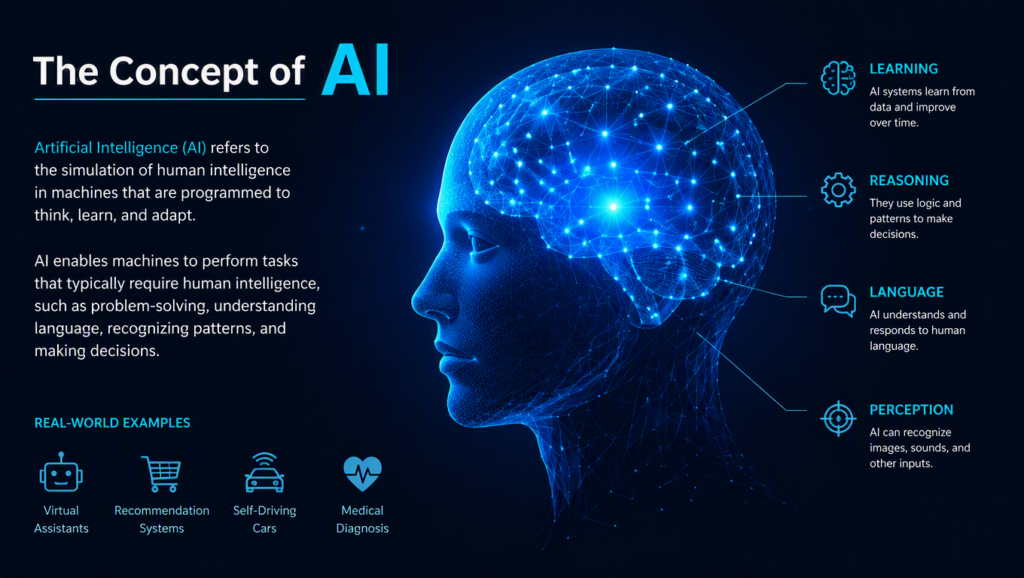
Artificial Intelligence is the transformative branch of computer science dedicated to building systems capable of performing tasks that typically require human intellect. These advanced systems process vast amounts of data, recognize complex patterns, and execute decision-making processes autonomously.
Modern AI encompasses several core disciplines, including machine learning, natural language processing, and computer vision. Machine learning algorithms allow software applications to improve their accuracy over time without explicit programming. Consequently, AI applications power everyday technologies, from virtual assistants and fraud detection systems to autonomous vehicles and medical diagnostic tools.
Organizations across all industries leverage artificial intelligence to optimize operations, enhance productivity, and foster innovation. As developers refine these technologies, AI continues to reshape the global economy and redefine human capabilities. Explore our resources to understand how artificial intelligence creates new opportunities for your enterprise and daily life.
The Pioneers
Alan Turing laid the foundational framework for machine intelligence. John McCarthy coined the term “Artificial Intelligence” and spearheaded the 1956 Dartmouth Workshop. Later, pioneers like Geoffrey Hinton, Yann LeCun, and Yoshua Bengio unlocked the immense potential of deep learning, driving the algorithms that define today’s digital landscape.
The Concept
Artificial Intelligence dominates modern headlines, yet many individuals still wonder what the term truly entails. At its core, the AI concept represents a paradigm shift in computing. Traditional software requires explicit, human-written instructions for every single action. Conversely, Artificial Intelligence empowers machines to process information, learn from experience, and execute complex tasks autonomously.
Moving Beyond Science Fiction
Popular media often depicts AI as sentient robots taking over the world. However, the practical AI concept focuses on narrow, utilitarian applications. Current systems excel at specific, bounded objectives—such as diagnosing diseases, optimizing supply chains, or recommending content—rather than possessing conscious thought.
Engineers design algorithms to handle data-intensive operations at unprecedented speeds. By automating repetitive analytical tasks, AI frees human professionals to focus on creative problem-solving, strategic planning, and emotional intelligence.
Core Capabilities
Machine Learning: Algorithms analyze vast datasets to identify patterns, forecast trends, and refine decision-making without human intervention.
Natural Language Processing: Systems interpret human communication, enabling seamless interactions through automated translation, sentiment analysis, and intelligent virtual assistants.
Computer Vision: Advanced visual recognition tools process digital images and videos, empowering applications to monitor quality, detect anomalies, and enhance security.
Robotic Process Automation: Software agents perform repetitive digital tasks with accuracy, allowing human teams to concentrate on strategic initiatives.
These technologies transform abstract theory into practical tools that drive modern society forward.
How does it work?
First, AI systems require vast amounts of data. Developers feed millions of examples into the system, which establishes a robust foundation for analysis.
Next, sophisticated algorithms process this information. These mathematical instructions enable the computer to recognize patterns, categorize information, and make predictions without human intervention.
Finally, machine learning empowers systems to improve over time. When the AI processes new data, it refines its internal logic and increases its accuracy. Deep learning, a specialized subset, utilizes artificial neural networks modeled after the human brain to solve intricate problems.
Real-world impact across industries
The AI concept touches nearly every sector of the global economy. Understanding these applications illustrates the true value of intelligent systems:
Healthcare: Algorithms analyze medical imagery to detect anomalies earlier than human doctors manage alone. Researchers also utilize AI models to accelerate pharmaceutical drug discovery.
Finance: Automated systems monitor transactions in real-time, instantly flagging fraudulent activities and protecting consumer accounts.
Transportation: Autonomous vehicle developers harness sensor data and predictive modeling to navigate complex road environments safely.
Customer Experience: Intelligent virtual assistants provide immediate, personalized support, streamlining service delivery for global enterprises.
How businesses and consumers benefit
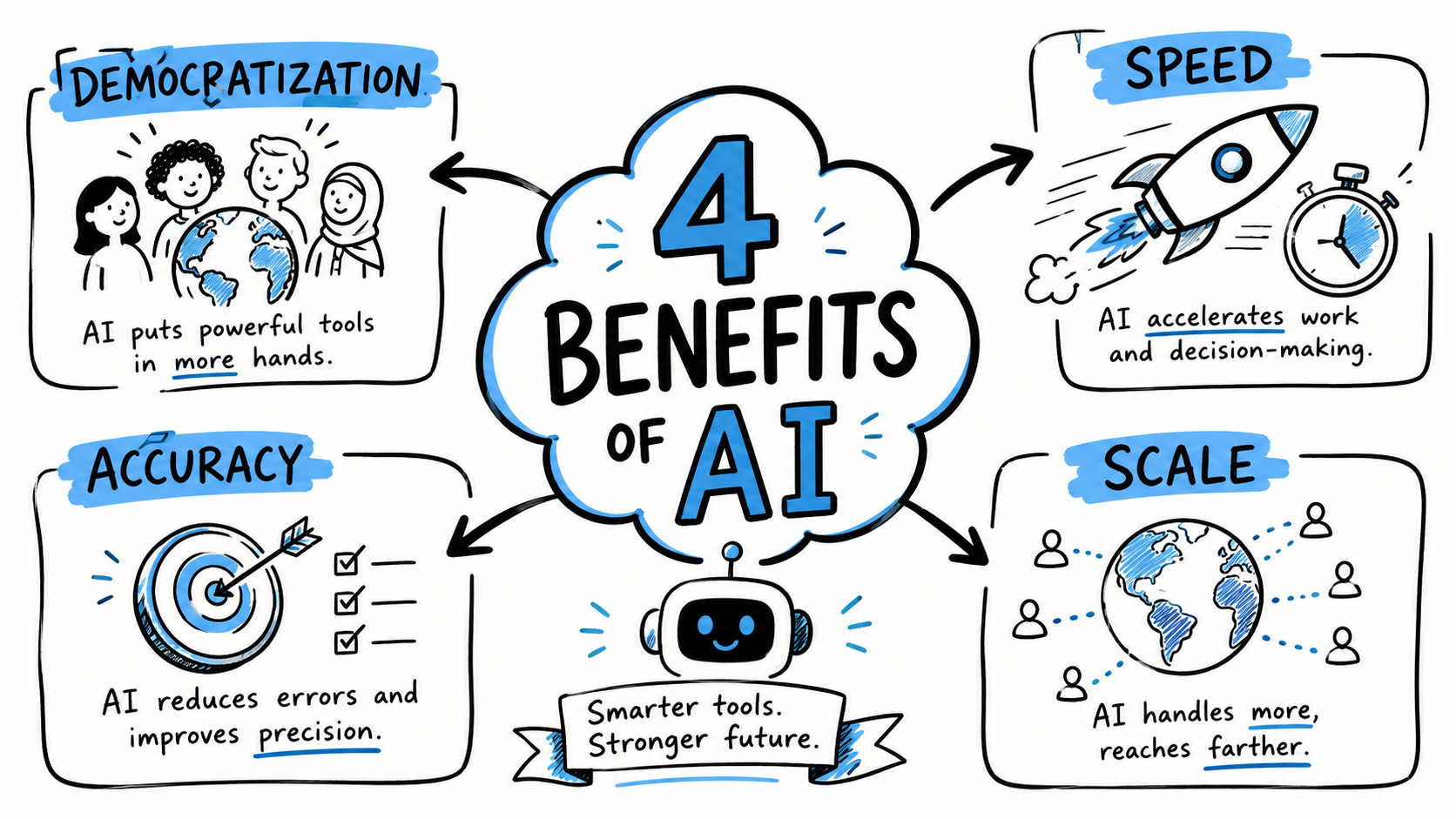
Democratization
Empowers non-technical users to query data via simple prompts. Smart algorithms and machine learning tools empower everyday individuals to create, learn, and innovate without requiring extensive technical expertise. For instance, generative AI platforms democratize software development by allowing non-programmers to build applications using natural language. Similarly, AI-driven educational tools provide personalized tutoring, granting students worldwide access to world-class instruction regardless of geographic or financial constraints.
Speed
Accelerates workflows AND Processes billions of data points much faster than human teams. In today’s fast-paced digital landscape, artificial intelligence transforms how organizations operate and deliver results. Traditional workflows often encounter bottlenecks, but smart automation eliminates these delays. Intelligent systems process vast amounts of data within seconds, freeing human teams to focus on strategic innovation.
Accuracy
Reduces manual counting mistakes and human bias. Artificial Intelligence transforms modern industries by redefining operational precision. Traditional methods often rely on human judgment, which fatigue and cognitive limits inherently compromise. Conversely, intelligent algorithms process vast datasets instantaneously, eliminating manual errors and delivering unprecedented consistency.
Scale
Handles multi-dimensional, complex data sources all at once. Smart algorithms manage repetitive tasks, freeing human teams to focus on high-level strategy. This automation accelerates output without requiring proportional increases in headcount.

Open source products
Projects like Meta’s LLaMA and Mistral provide powerful foundation models that rival commercial alternatives, enabling custom natural language processing applications. PyTorch and TensorFlow remain the backbone of deep learning research, offering robust libraries for neural network development. Platforms such as Hugging Face democratize access to thousands of pre-trained models, streamlining deployment workflows.
Product development by businesses
Microsoft and Google spearhead cloud-based AI integration, empowering enterprises worldwide with scalable intelligence and deep learning frameworks. Meanwhile, OpenAI and Anthropic push the boundaries of generative models, transforming how humans interact with digital systems. In hardware development, NVIDIA provides the essential computational power that drives heavy neural network training. Furthermore, pioneers like Tesla apply computer vision to autonomous transport, proving the vast practical applications of smart algorithms.
Key enterprise grade applications
Leading platforms like OpenAI’s ChatGPT and Google Gemini empower professionals to generate content, analyze complex data, and automate routine communications efficiently. Meanwhile, creative enterprises utilize tools such as Midjourney and Adobe Firefly to produce high-resolution visual assets instantly, reducing both production time and overhead costs. For data-driven enterprises, robust analytics solutions like Salesforce Einstein and Microsoft Copilot integrate seamlessly into existing ecosystems, delivering actionable insights that drive strategic decision-making.
What are the challenges?
Bias and Fairness
Developers train algorithms on historical human data. Unfortunately, human history contains systemic prejudices. Consequently, AI systems frequently absorb and amplify these biases. Biased algorithms often deny qualified individuals loans, misidentify minority faces in surveillance systems, or skew hiring processes.
Accountability and Transparency
When an autonomous vehicle causes an accident or an algorithm makes a faulty medical diagnosis, society faces a difficult question: Who bears the responsibility?
Privacy and Surveillance
Modern AI thrives on vast quantities of personal data. Corporations and governments track browsing habits, biometric markers, and location data constantly. This relentless data harvesting threatens individual autonomy and creates unprecedented surveillance capabilities.
10 most frequently asked questions and answers
This guide addresses ten essential questions about artificial intelligence to clarify its functions, impacts, and future trajectory.
What actually defines Artificial Intelligence?
Artificial Intelligence refers to computer systems designed to perform tasks that typically require human intellect. These tasks include learning from experience, recognizing speech, reasoning, solving problems, and translating languages. Instead of following rigid, pre-written code, AI algorithms analyze vast datasets to identify patterns and make autonomous decisions.
How does machine learning differ from AI?
Machine learning serves as a core subset of artificial intelligence. While AI is the overarching concept of machines mimicking human intelligence, machine learning provides the technical mechanism that allows computers to learn from data without explicit programming. Programmers feed data into a machine learning model, and the system improves its performance over time independently.
Will artificial intelligence replace human jobs?
AI automation transforms the labor market rather than entirely eradicating human employment. While algorithms take over repetitive, manual, and routine tasks, they simultaneously generate demand for new professions. Roles in AI ethics, data analysis, systems engineering, and prompt engineering currently expand rapidly, requiring workers to adapt their skills rather than face obsolescence.
Is artificial intelligence safe to use?
Developers prioritize safety through rigorous testing, ethical guidelines, and security protocols. However, risks persist. Cybersecurity vulnerabilities, biased decision-making, and data privacy concerns present legitimate challenges. Regulatory bodies and technology leaders continuously establish governance frameworks to mitigate these risks and ensure responsible AI deployment.
How do generative AI systems create content?
Generative AI models—such as text and image generators—utilize deep learning networks to analyze billions of examples of human-created content. When a user submits a prompt, the system predicts the most statistically accurate sequence of words or pixels to fulfill the request. Consequently, the software generates original text, artwork, or music based on learned patterns.
Does AI possess consciousness or emotions?
AI lacks consciousness, self-awareness, and genuine emotions. Advanced chatbots and virtual assistants simulate empathetic conversation by processing linguistic cues, but they do not feel feelings or hold personal beliefs. They operate purely as mathematical and statistical processors executing software instructions.
How do organizations protect user privacy with AI?
Data privacy requires strict compliance with regulations such as the General Data Protection Regulation (GDPR) and the California Consumer Privacy Act (CCPA). Reputable companies anonymize personal data, utilize secure cloud storage, and implement encryption standards. Users should always review privacy policies before sharing sensitive information with third-party applications.
What major industries benefit most from AI implementation?
Healthcare, finance, transportation, and manufacturing reap the greatest advantages from AI integration. Healthcare providers utilize diagnostic algorithms to detect diseases earlier. Financial institutions deploy fraud-detection models to secure transactions. Meanwhile, manufacturing companies optimize supply chains and predictive maintenance through automated robotics.
Can artificial intelligence exhibit bias?
AI systems can indeed exhibit bias. Because algorithms learn from historical human data, they often internalize and replicate existing societal prejudices. Developers combat this issue by curating diverse training datasets, auditing algorithms regularly, and applying fairness metrics during the software development lifecycle.
What does the future hold for artificial intelligence?
The future of artificial intelligence promises enhanced integration into daily infrastructure, breakthroughs in scientific research, and more intuitive human-computer interfaces. As quantum computing converges with AI, computational capabilities will accelerate exponentially. Society must balance innovation with thoughtful regulation to ensure artificial intelligence serves the collective good.


