Saturday, November 21
AI Training

How do I master AI?

How do I master AI? Here are the core competencies to gian proficiency in AI Skill Level Focus Area Key Technologies Beginner Basic Programming & Statistics Pandas, NumPy Intermediate Supervised & Unsupervised Learning Scikit-Learn, PyTorch, TensorFlow Advanced Deep Learning & Neural Networks CNNs, RNNs, Transformers Expert Architecture Design & MLOps Kubernetes, Triton, Custom Loss Functions Scientific literature from the Association for Computing Machinery (ACM) emphasizes that practitioners must understand model interpretability. Black-box models create governance risks in healthcare and finance. Artificial Intelligence transforms industries, economies, and scientific research. Becoming an expert requires deliberate pra...
AI Training

Why Study Artificial Intelligence

Artificial intelligence shapes modern systems across society. Machines now process vast amounts of data, recognize patterns, and execute complex decisions. Studying this technology provides individuals with the analytical tools required to understand and influence technological progress. Academic institutions and research laboratories worldwide report unprecedented demand for courses focused on machine learning, neural networks, and algorithmic design. The Academic Imperative Higher education institutions now prioritize computer science and computational logic within their core curricula. Stanford University and the Massachusetts Institute of Technology offer specialized degree tracks dedicated entirely to machine intelligence. These programs examine the mathematical foundations of proba...
Convolutional Neural Network

Who discovered Convolutional Neural Networks?

Who discovered Convolutional Neural Networks? Hubel and Wiesel provided the biological blueprint. Kunihiko Fukushima engineered the first architectural framework. Yann LeCun perfected the training methodology with LeNet-5, and Alex Krizhevsky, Ilya Sutskever, and Geoffrey Hinton unleashed its modern potential. Together, these brilliant minds built the foundation of computer vision, transforming how machines perceive and interpret the visual world. Every time facial recognition software unlocks your phone or a medical imaging system detects an early-stage illness, Convolutional Neural Networks (CNNs) perform the heavy lifting. These specialized architectures power modern computer vision, but their origins stretch back decades. Understanding the history of CNNs requires looking pas...
Convolutional Neural Network

Who are the top researchers in deep learning?

The three top researchers in deep learning are: Geoffrey Hinton: Often called the "Godfather of Deep Learning," Professor Hinton pioneered backpropagation algorithms and the development of Boltzmann machines. His groundbreaking work at the University of Toronto and Google fundamentally redefined computer vision and speech recognition. Yann LeCun: As Chief AI Scientist at Meta and a professor at New York University, LeCun invented Convolutional Neural Networks (CNNs). His innovations enable computers to process and understand visual imagery with remarkable accuracy, powering applications from facial recognition to satellite imaging. Yoshua Bengio: Based at the Université de Montréal, Bengio shaped our understanding of recurrent neural networks and probabilistic language models. His p...
Finance AI

What are AI applications in Finance?

What are AI applications in Finance?  They are smart algorithms that analyze millions of transactions in real time to spot irregularities instantly. They are required in the banking and money sector because Artificial Intelligence (AI) no longer belongs strictly to the realm of science fiction. Today, financial institutions harness advanced algorithms and machine learning models to reshape how the global economy operates. From everyday banking to complex market analysis, AI delivers unprecedented speed, precision, and security. Discover how modern financial systems leverage artificial intelligence to redefine efficiency and value. 1. Fortifying Security Through Fraud Detection Financial fraud costs organizations billions of dollars annually. Traditional security measures often fail ag...
Convolutional Neural Network

What is pooling in convolutional neural networks?

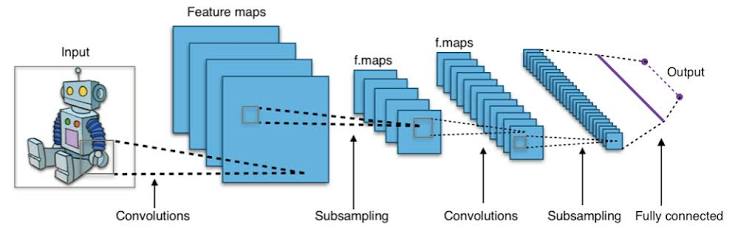
What is Pooling? Pooling sits between the convolutional layers of a neural network. After a convolutional layer extracts features—such as edges, shapes, and textures—the pooling layer condenses the resulting feature maps. Artificial intelligence relies heavily on Convolutional Neural Networks (CNNs) to process and understand visual data. When computers analyze images, they manage millions of pixels, which demands immense computational power. To solve this challenge, engineers use a technique called pooling. Pooling reduces the dimensions of data, making image processing faster and more efficient while preserving essential features. The process operates by sliding a small window, known as a filter, across the feature map. This window summarizes the values within its boundary, signific...
Convolutional Neural Network

What are hidden layers in a convolutional neural network?

Engineers call them "hidden layers" because they neither receive data directly from the external world nor produce the final classification. Data enters the network through the input layer and exits through the output layer. Between these two points lies a series of hidden layers.  Instead, they perform the intricate calculations that make accurate predictions possible. Artificial intelligence now diagnoses medical scans, powers autonomous vehicles, and recognizes faces in milliseconds. Behind these remarkable feats lies a sophisticated architecture known as the Convolutional Neural Network (CNN). While input images and final predictions capture most of the attention, the true computational magic happens deep within the system. Hidden layers drive this process, transforming raw pixels i...
AI Tester

What Is the Role of an AI Tester in Application Development?

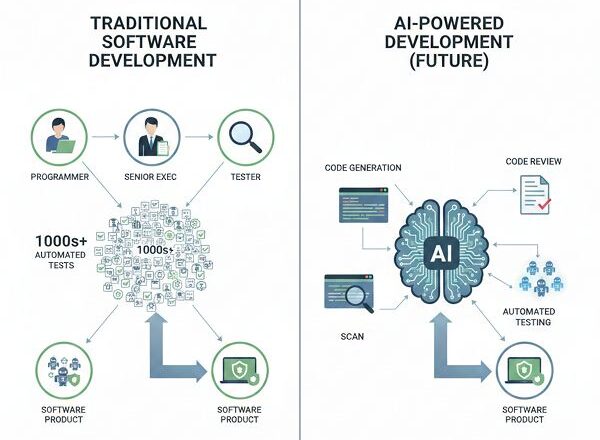
An AI tester in application development is an Software Expert who ensures that AI features of a system such as machine learning capabilities achieve quality, accuracy, security, robustness and scalability as intended by the functional specifications of the product Stakeholders. In today’s software landscape, artificial‑intelligence (AI) features appear in everything from chatbots to predictive analytics. Building reliable AI‑driven applications demands a specialist who understands both conventional testing methods and the nuances of machine‑learning models. That specialist is the AI tester. Below, we outline the core responsibilities, required skills, and business impact of this vital role. 1. Define Test Strategy for AI‑Enabled Modules An AI tester starts by mapping the entire lif...
Convolutional Neural Network

Are convolutional neural networks and other networks the same?

No. Traditional artificial neural networks process data as flat vectors, but Convolutional Neural Networks (CNNs) revolutionize computer vision and spatial data analysis. Understanding the architectural differences between CNNs and standard Multi-Layer Perceptrons (MLPs) reveals why modern technology excels at recognizing images, videos, and complex patterns. The Limitation of Traditional Neural Networks Standard neural networks utilize fully connected layers. Every single neuron in one layer connects to every neuron in the subsequent layer. While this architecture handles generic tabular data effectively, it struggles immensely with visual information. Consider a standard digital image. A modest high-definition photograph contains millions of pixels. Feeding this massive volume of da...
Artificial Intelligence

What do you know about artificial intelligence?

Artificial Intelligence (AI) shapes daily life in profound ways. From smartphone facial recognition to the complex algorithms that forecast global weather patterns, AI operates at the forefront of modern innovation. Many individuals view AI as a futuristic concept confined to science fiction, yet the technology currently drives the global economy, transforms healthcare, and redefines human capability. Understanding AI requires looking past cinematic myths to examine the actual mechanisms, applications, and trajectory of this transformative technology. This guide breaks down artificial intelligence into clear concepts, exploring its history, current functions, and future impact on society. Defining Artificial Intelligence: Beyond the Hype Fundamentally, artificial intelligence denotes ...
Copyright | KwasiSaah.com Terms Privacy Cookie
Αυτός που δεσμεύεται πρέπει να αποδώσει