


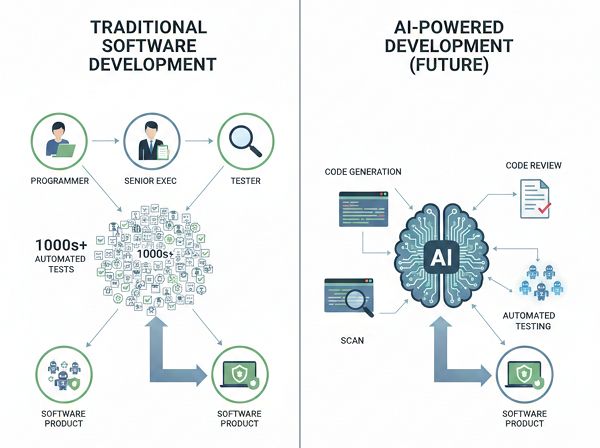
An AI tester in application development is an Software Expert who ensures that AI features of a system such as machine learning capabilities achieve quality, accuracy, security, robustness and scalability as intended by the functional specifications of the product Stakeholders.
In today’s software landscape, artificial‑intelligence (AI) features appear in everything from chatbots to predictive analytics. Building reliable AI‑driven applications demands a specialist who understands both conventional testing methods and the nuances of machine‑learning models. That specialist is the AI tester.
Below, we outline the core responsibilities, required skills, and business impact of this vital role.
1. Define Test Strategy for AI‑Enabled Modules
An AI tester starts by mapping the entire lifecycle of the model—data collection, training, validation, deployment, and monitoring. She designs a test plan that covers:
| Test Area | What the AI Tester Does |
|---|---|
| Data Quality | Audits raw datasets for missing values, outliers, and labeling errors that could skew model performance. |
| Model Accuracy | Executes benchmark tests, compares predictions against ground‑truth datasets, and documents precision, recall, and F1 scores. |
| Bias & Fairness | Checks for demographic parity, recognizes instances of disparate impact, and proposes methods for mitigation. |
| Performance & Scalability | Measures latency, throughput, and resource consumption under realistic workloads. |
| Security & Robustness | Performs adversarial testing, simulates input alterations, and confirms that the model is resilient against attacks. |
By covering these dimensions, the AI tester ensures that the model behaves predictably and ethically before it reaches production.
2. Integrate AI Tests into CI/CD Pipelines
Modern development teams rely on Continuous Integration/Continuous Deployment (CI/CD) to deliver updates rapidly. An AI tester scripts automated test suites that run on every code commit. She configures:
- Unit tests for individual model functions.
- Integration tests that validate data flow between the model and surrounding services.
- Regression tests that compare new model versions against baseline metrics.
When a test fails, the AI tester provides immediate, actionable feedback, allowing developers to address issues before they cascade downstream.
3. Monitor Deployed Models in Real Time
After deployment, the AI tester sets up monitoring dashboards that track key indicators such as drift, confidence scores, and error rates. She defines alert thresholds so that the operations team receives notifications the moment performance degrades. By continuously validating the model against live data, the AI tester safeguards the application against hidden decay.
4. Collaborate Across Disciplines
Successful AI testing requires a cross‑functional approach. The AI tester partners with:
- Data scientists to understand feature engineering choices and model assumptions.
- Software engineers to embed test hooks and ensure testability of code.
- Product owners to align test objectives with business goals, such as user satisfaction or compliance requirements.
Through clear communication and shared documentation, the AI tester translates technical findings into business‑relevant insights.
The professional qualities of an AI Tester
In order to perform their duties assiduously, the AI tester must ideally:
- Hold certifications in AI/ML testing, data analytics, and relevant programming languages (Java, SQL).
- Possess a portfolio of projects where AI models met stringent accuracy, fairness, and regulatory standards.
- Publish best‑practice whitepapers, contribute to industry forums, and stay current with standards such as ISO/IEC 20546.
- Maintains transparent test reports, versioned artifacts, and audit trails that satisfy internal auditors and external regulators.
Why Your Organization Needs an AI Tester
- Reduce Risk: Early detection of bias, security flaws, and performance bottlenecks prevents costly post‑release fixes.
- Accelerate Delivery: Automated AI test suites keep CI/CD pipelines fast while preserving quality.
- Ensure Compliance: Structured testing aligns with emerging AI regulations (e.g., EU AI Act), protecting your brand reputation.
- Boost User Confidence: Consistently accurate and fair AI behavior increases user trust and adoption rates.
Summary
In summary, the AI tester acts as the guardian of reliability for every intelligent component in your application. She designs comprehensive test strategies, embeds them into automated pipelines, monitors models in production, and collaborates across teams to turn data‑driven insights into trustworthy software. Investing in an experienced AI tester not only safeguards your product but also empowers your organization to innovate confidently in the age of artificial intelligence.


