


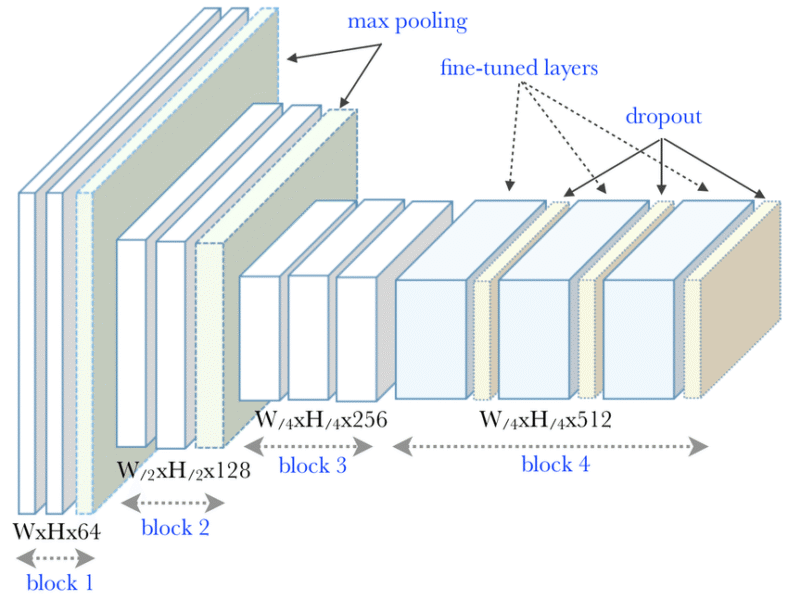
Here are the 4 layers of Convolutional Neural Networks?
1. The Convolutional Layer: The Feature Extractor
Serving as the essential building block of any CNN, the convolutional layer applies mathematical filters to the input image, enabling the extraction of key features such as edges, textures, and gradients.
As the filter slides across the image pixels, it calculates dot products to generate a feature map. Early layers detect simple elements like horizontal lines, while deeper layers recognize complex structures like eyes, wheels, or faces.
2. The ReLU Layer: Introducing Non-Linearity
Following the convolutional layer, the Rectified Linear Unit (ReLU) layer introduces non-linearity into the model. Real-world data contains complex, non-linear relationships that linear equations cannot represent adequately.
The ReLU function processes every negative value in the feature map and converts it to zero, while retaining positive values. This operation allows the network to learn intricate patterns rapidly without significantly increasing computational complexity.
3. The Pooling Layer: Reducing Dimensionality
Images contain vast amounts of data, which can overwhelm computational resources and cause overfitting. The pooling layer solves this challenge by downsampling the feature maps.
This layer summarizes regions of the feature map, typically using maximum values (Max Pooling) or average values. By reducing the spatial dimensions, the pooling layer decreases the parameter count, minimizes computation time, and ensures the network detects features regardless of minor positional shifts.
4. The Fully Connected Layer: Making the Final Decision
The final stage of the architecture involves the Fully Connected (FC) layer. Unlike the previous layers that maintain spatial structures, the fully connected layer flattens the multi-dimensional feature maps into a single one-dimensional vector.
Artificial intelligence powers everything from facial recognition software to autonomous vehicles. Behind these technological advancements lies a powerful architecture known as the Convolutional Neural Network (CNN). CNNs process visual data with remarkable accuracy by mimicking the human visual cortex.
Understanding how these networks function begins with examining their foundational architecture. A standard CNN relies on four distinct types of layers to analyze, interpret, and classify images.
Every neuron in this layer connects to every neuron in the preceding layer. The FC layer integrates all the extracted features to determine the final output, applying a softmax or sigmoid activation function to generate class probabilities for image classification tasks.
Harness the Power of Deep Learning
Convolutional Neural Networks transform raw pixels into actionable insights through this precise four-layer sequence. Each layer builds upon the work of the previous one, creating a sophisticated system capable of interpreting the visual world with astonishing precision.
Are you ready to implement machine learning solutions in your organization? Contact our team of AI experts today to discuss your next project.


