


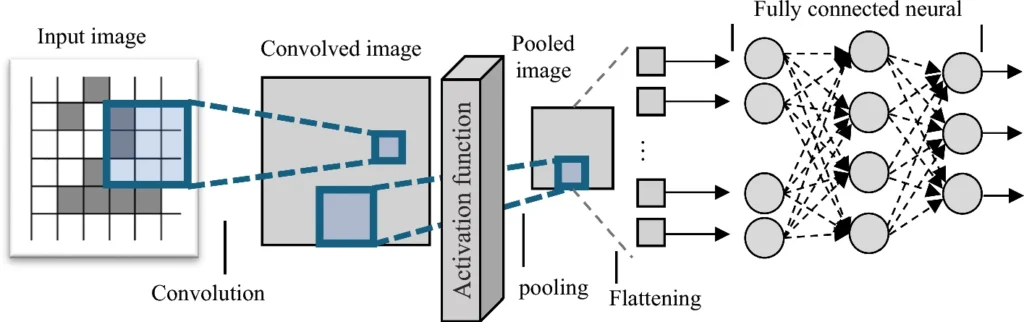
What is Pooling? Pooling sits between the convolutional layers of a neural network. After a convolutional layer extracts features—such as edges, shapes, and textures—the pooling layer condenses the resulting feature maps.
Artificial intelligence relies heavily on Convolutional Neural Networks (CNNs) to process and understand visual data. When computers analyze images, they manage millions of pixels, which demands immense computational power. To solve this challenge, engineers use a technique called pooling. Pooling reduces the dimensions of data, making image processing faster and more efficient while preserving essential features.
The process operates by sliding a small window, known as a filter, across the feature map. This window summarizes the values within its boundary, significantly shrinking the data matrix. This reduction lowers the computational load, limits memory consumption, and prevents the network from overfitting to the training data.
Primary Types of Pooling Operations
1. Max Pooling
Max pooling extracts the maximum value from the region covered by the filter. Because it retains the most prominent features—like a sharp edge or a bright spot—this method works exceptionally well for object detection and image classification.
2. Average Pooling
Average pooling calculates the mathematical mean of all values within the filter’s window. This approach smooths the feature map, retaining background information and overall patterns rather than sharp, distinct features.
Why CNNs Require Pooling
Integrating pooling layers into a neural network architecture delivers several critical benefits:
- Dimensionality Reduction: Pooling shrinks image dimensions drastically, which accelerates training and inference times.
- Translation Invariance: A pooling layer helps the network recognize an object even if its position shifts slightly within the image. If an object moves a few pixels, the maximum or average value within the pooling window often remains identical.
- Overfitting Prevention: By reducing the total number of parameters and variables in the network, pooling helps the model generalize better to new, unseen data.
Real-World Applications
Convolutional Neural Networks power technologies across industries, and pooling plays a vital role in every application:
- Autonomous vehicles make use of CNNs that incorporate pooling layers to interpret live camera feeds, allowing for the immediate detection of pedestrians, traffic signs, and other automobiles.
- Healthcare Diagnostics: Medical imaging systems apply pooling techniques to analyze X-rays, MRIs, and CT scans, helping doctors detect anomalies like tumors with high accuracy.
- Facial Recognition: Security systems and mobile devices leverage these networks to map facial structures and authenticate users securely in real time.
Conclusion
Pooling serves as a foundational building block in modern computer vision. By compressing feature maps, filtering out redundant information, and maintaining core structural insights, pooling allows machines to interpret visual data with remarkable speed and precision. As artificial intelligence continues to evolve, optimized pooling strategies will drive even more advanced computer vision breakthroughs.


